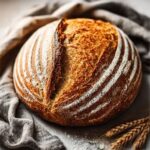
Description
Master the perfect sourdough loaf! This recipe uses autolyse and four sets of stretch-and-folds to guarantee a complex, airy crumb and superior crust. Detailed steps and full nutrition guide provided.
Ingredients
- Active Sourdough Starter (levain): 100 grams
- High-Protein Bread Flour: 400 grams
- Whole Wheat Flour: 50 grams
- Lukewarm Water (approximately 90°F / 32°C): 350 grams
- Fine Sea Salt: 10 grams
- Rice Flour (for dusting banneton): As needed
Instructions
- Step 1: The Mix and Autolyse. In a large bowl, whisk the starter and water together until dissolved. Add both flours and mix thoroughly with your hand until no dry flour remains (this is the shaggy mass). Cover and let rest for 30 minutes (autolyse). Next, sprinkle the salt over the dough and wet your hand; squeeze and fold the dough for 2 minutes until the salt is fully incorporated.
- Step 2: Bulk Fermentation and Strength Building. Over the next 3 to 4 hours, perform a series of four "stretch and folds" every 30 minutes. Gently stretch the dough up from one side and fold it over itself (turning the bowl 90 degrees each time). After the folds are complete, allow the dough to continue bulk fermenting until it has increased in volume by about 30-50% and feels bubbly and airy.
- Step 3: Shaping and Cold Proofing. Gently turn the dough out onto a lightly floured surface and pre-shape it into a loose round. Rest for 20 minutes (bench rest). Flip the dough, shape it tightly into a boule or batard, and place it seam-side-up into a banneton heavily dusted with rice flour. Cover the banneton tightly and transfer it to the refrigerator to cold proof for 12 to 18 hours.
- Step 4: Preheat the Oven and Dutch Oven. One hour before baking, preheat your oven to 500°F (260°C) with a Dutch oven placed inside. Ensure the Dutch oven is fully hot before proceeding to the next step.
- Step 5: Score and Bake. Carefully invert the cold dough onto a piece of parchment paper. Use a sharp razor (lame) to score the top deeply. Carefully transfer the dough and parchment into the hot Dutch oven, cover with the lid, and reduce the oven temperature to 475°F (245°C). Bake covered for 20 minutes, then remove the lid and continue baking for an additional 25-30 minutes until the crust is deep golden brown.
- Step 6: Cooling. Remove the loaf from the Dutch oven and transfer it to a wire rack. Allow the bread to cool completely (at least 2 hours) before slicing to ensure the internal crumb sets properly.
Notes
- For optimum freshness, store the cooled loaf cut-side-down on a wooden board or wrapped loosely in a clean linen towel at room temperature, as refrigeration rapidly dries out the crumb.
- To restore a crisp crust, briefly spritz the cooled loaf with water and reheat it on a bare oven rack at 350°F (175°C) for 8 to 10 minutes.
- This slightly rustic loaf shines when served alongside a cheese board or used as the perfect vehicle for a classic avocado toast topped with everything bagel seasoning.
- Chef’s Tip: Do not slice the bread prematurely; the required two-hour minimum cooling time allows internal steam to dissipate and sets the starch structure, guaranteeing a light, non-gummy crumb.
- Prep Time: 15 minutes
- Cook Time: 20 minutes
- Method: Stovetop
- Cuisine: American
Nutrition
- Serving Size: 1 slice (approx. 75g)
- Calories: 155
- Sodium: 340mg
- Fat: 0.5g
- Saturated Fat: 0g
- Trans Fat: 0g
- Protein: 0g